Bombing of the city
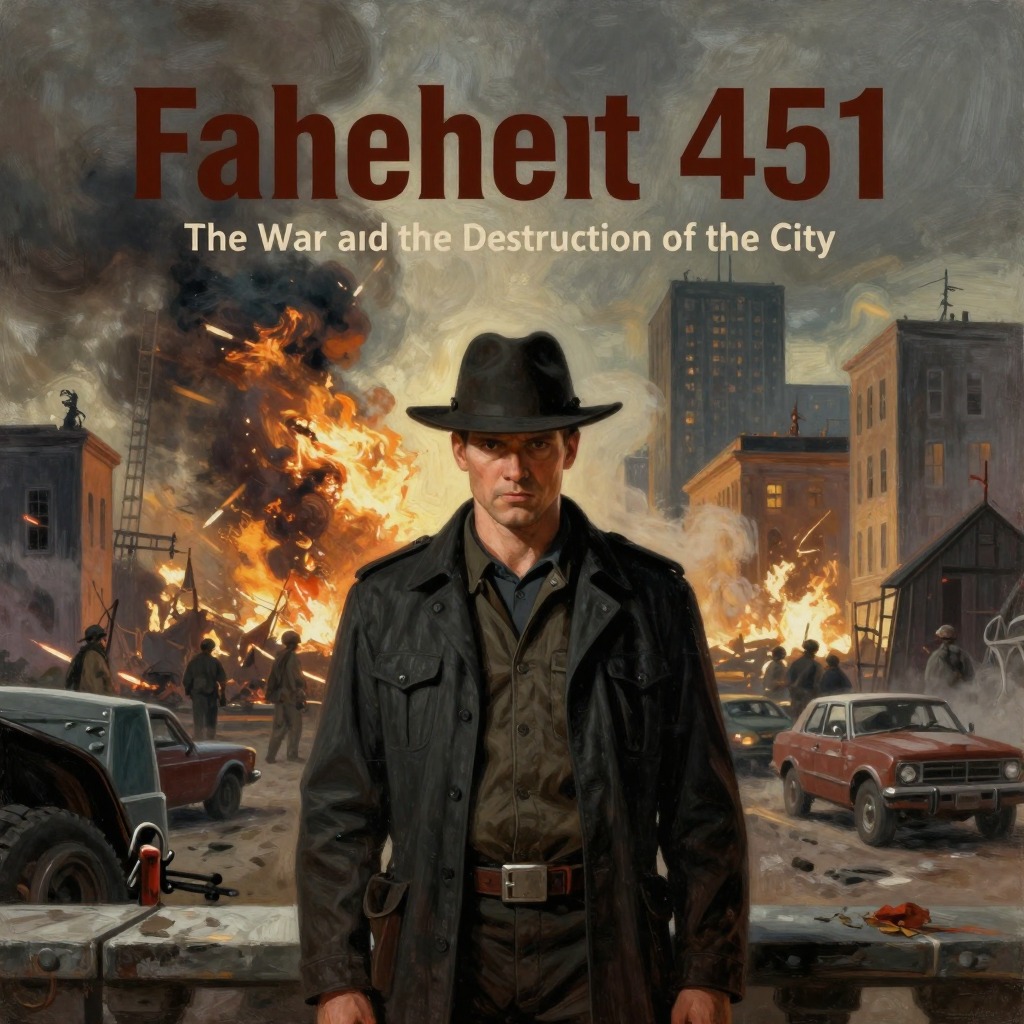
The bombing of the city is the apocalyptic climax of Fahrenheit 451, in which the long-anticipated war finally arrives and destroys the metropolis in a single, instantaneous attack, killing Mildred and countless others while Montag and the book people survive in the wilderness, witnessing the end of the civilization they fled.
Background and Buildup
Throughout the novel, the threat of war hangs over the narrative like a constant, low-grade fever. Jet bombers scream across the sky at all hours, and radio broadcasts casually mention mobilization figures. Montag himself hears a voice on the Seashell radio announce, "We have mobilized a million men. Quick victory is ours if the war comes," only to have Faber whisper in his other ear, "Ten million men mobilized. But say one million. It's happier." The war is not a surprise; it is the inevitable destination of a society that has traded thought for pleasure. The night before the bombing, Montag feels it in the very atmosphere: "You could feel the war getting ready in the sky that night. The way the clouds moved aside and came back, and the way the stars looked, a million of them swimming between the clouds, like the enemy discs, and the feeling that the sky might fall upon the city and turn it to chalk dust, and the moon go up in red fire." The city, wrapped in its own "coat of a thousand colours," has ignored the approaching catastrophe, and the book people have been waiting for it, knowing that the culture is "flinging itself to pieces."
The Instant of Destruction
The war begins and ends in a single, almost imperceptible instant. Montag and the men around the campfire cannot later say if they really saw anything—perhaps "the merest flourish of light and motion in the sky." The jets appear ten miles, five miles, one mile up, like "grain thrown over the heavens by a great sowing hand," and the bombs drift downward with "dreadful swiftness, yet sudden slowness." The entire bombardment is finished once the jets have sighted their target; as quick as "the whisper of a scythe," the war is over. Montag sees "the flirt of a great metal fist over the far city" and knows that the scream of the jets will follow after the deed, commanding the city to "disintegrate, leave no stone on another, perish. Die." In that half-second remaining, Montag's mind reaches out to the people he has lost: he cries to Faber, to Clarisse, to Mildred to run, but Clarisse is already dead, Faber is on a bus somewhere in the deep valleys, and Mildred is in her hotel room, leaning toward the great shimmering walls of colour and motion, where the family talks and talks to her, saying nothing of the bomb that is now an inch, a half-inch, a quarter-inch from the top of the hotel.
Mildred's Death and Montag's Memory
The first bomb strikes, and Montag, falling flat, sees or imagines he sees the walls go dark in Mildred's face. In the millionth part of time left, she sees her own face reflected in a mirror instead of a crystal ball—"such a wildly empty face, all by itself in the room, touching nothing, starved and eating of itself"—and recognizes it as her own. She looks up at the ceiling as the entire structure of the hotel blasts down upon her, carrying her with a million pounds of brick, metal, plaster, and wood to meet other people in the hives below. In that same moment, the concussion knocks the air across and down the river, turning the men over like dominoes, blowing the water in lifting sprays, and making the trees mourn with a great wind passing away south. Montag, crushed against the earth, blinks once and sees the city, instead of the bombs, in the air: the city stands, rebuilt and unrecognizable, taller than it has ever hoped or strived to be, erected in gouts of shattered concrete and sparkles of torn metal into a mural hung like a reversed avalanche, a million colours, a million oddities—a door where a window should be, a top for a bottom, a side for a back—and then the city rolls over and falls down dead. Lying there, eyes gritted shut with dust, Montag suddenly remembers: Chicago, a long time ago. That is where he and Mildred met. And then, unbidden, the words of Ecclesiastes come to him, perfect and without trying, with no Denham's Dentifrice anywhere—just the Preacher by himself, standing there in his mind, looking at him.
Aftermath and the New Dawn
After the shock wave passes, the men lie gasping like fish laid out on the grass, holding to the earth as children hold to familiar things. Granger arises, feels his arms and legs, swearing under his breath with tears dripping from his face. He shuffles down to the river to look upstream and reports, "It's flat. City looks like a heap of baking-powder. It's gone." He wonders how many knew it was coming, how many were surprised. Montag thinks of how many other cities are dead across the world—a hundred, a thousand. Someone strikes a match and touches it to a piece of dry paper, and the fire grows larger in the early morning as the sun comes up. The men turn from looking upriver and are drawn to the fire, awkwardly, with nothing to say. Granger unfolds an oilskin with bacon, and they eat, slowly, thoughtfully. He speaks of the Phoenix, the silly bird that burns itself up and springs out of the ashes, and says that humans have one thing the Phoenix never had: "We know the damn silly thing we just did. We know all the damn silly things we've done for a thousand years, and as long as we know that and always have it around where we can see it, some day we'll stop making the goddam funeral pyres and jumping into the middle of them." They finish eating, put out the fire, and begin walking north. Montag finds that the others have fallen in behind him, and Granger nods him on. He looks at the river and the sky and the rusting track, and he feels the slow stir of words, the slow simmer. He knows that when it is his turn, he will offer the words from Revelation: "And on either side of the river was there a tree of life, which bare twelve manner of fruits, and yielded her fruit every month; And the leaves of the tree were for the healing of the nations." He thinks, "Yes, that's the one I'll save for noon. For noon... When we reach the city."